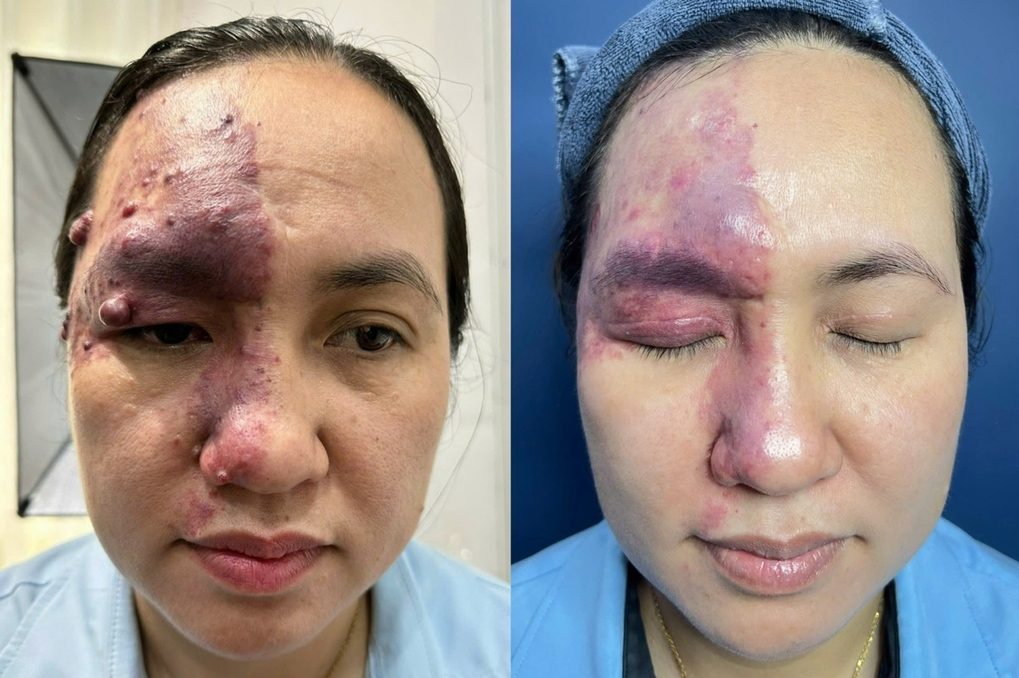
A port-wine stain is a pink, red or purple patch of skin present from birth, caused by abnormally formed capillaries in the skin. It affects about 3 in every 1,000 babies, does not go away on its own and often darkens and thickens with age. Pulsed dye laser fades it over many sessions, but rarely removes it completely.
Key points
- A port-wine stain is a capillary malformation (a fault in the smallest blood vessels of the skin), not a tumour. It is present at birth and does not disappear.
- It is usually caused by a GNAQ gene change that happens by chance while the baby develops. It is usually not inherited and is not caused by anything the mother did in pregnancy.
- A stain on the forehead or upper eyelid needs an eye check and possibly a brain MRI, because of the link with glaucoma and Sturge-Weber syndrome.
- Pulsed dye laser (585–595 nm) is the first-line treatment. Starting early, in infancy, tends to give better results.
- The aim is to make the stain paler. It can darken again years later, so long-term follow-up helps.
What is a port-wine stain?
A port-wine stain is a type of capillary malformation. Capillaries are the tiny blood vessels in the dermis, just below the outer skin. In a port-wine stain, these vessels are enlarged and more crowded than normal, so the skin above looks pink, red or purple, like spilled red wine.

A few numbers put it in context:
- How common: DermNet puts it at about 0.3% of newborns, or 3 in 1,000 babies. The British Association of Dermatologists (BAD) says boys and girls are affected equally.
- Where: about 65 in 100 people have the stain on the head and neck (BAD). It can also appear on the arms, legs or trunk.
- Does it go away: no. DermNet states that port-wine stains do not shrink or disappear on their own.
What causes a port-wine stain?
In 2013, a study in the New England Journal of Medicine identified the cause: a change in the GNAQ gene that happens in a group of cells while the baby is developing. This is a “somatic” change, meaning it is present only in some of the body’s cells.
Because of this, Great Ormond Street Hospital (UK) explains that a port-wine stain is not passed down from parents and is not known to be related to anything that happened during pregnancy, and KidsHealth describes most cases as “sporadic”. Cleveland Clinic notes rare cases where several members of one family are affected. Parents have nothing to blame themselves for.
How does a port-wine stain change with age?
At birth the stain is usually flat, smooth and pink or red. It grows in proportion as the child grows. Over time, especially on the face:
- The colour deepens from pink to red-purple.
- The skin thickens and becomes bumpy, sometimes with raised nodules that bleed easily.
- The tissue underneath can overgrow, making the lip, eyelid or cheek larger than the other side.
A review of 415 people with facial port-wine stains found that about 65% developed thickening or nodules by around age 50. Another study of 87 untreated people found that soft tissue overgrowth began on average at age 9. This is why many doctors recommend treating while the stain is still thin.
Port-wine stain, stork bite or haemangioma?
All three can appear as red marks on a baby, but they behave very differently.
| Port-wine stain | Stork bite / salmon patch (nevus simplex) | Infantile haemangioma (strawberry mark) | |
|---|---|---|---|
| When it appears | Present at birth | Present at birth | Usually in the first month |
| Common sites | Face, neck, one side of the body | Forehead, upper eyelids, back of the neck | Anywhere |
| Look | Flat pink, red or purple patch; thickens later | Flat light-pink patch | Raised, bright red, like a strawberry |
| What happens | Does not fade; darkens and thickens | On the forehead and eyelids usually fades within 1–2 years | Grows fast for 4–6 months, then slowly shrinks; most fade by age 10 |
| What to do | See a dermatologist; consider early laser | Usually just watch | Have it assessed to decide between watching and treatment |
Sources: Cleveland Clinic, NHS, DermNet. If you are not sure which type your child has, ask a dermatologist, because each is managed differently.
Is a port-wine stain dangerous?
In most people a port-wine stain is just a birthmark. Cleveland Clinic says port-wine stains are usually harmless and do not cause medical problems or pain; the impact is mainly on appearance and self-confidence. Two situations need a closer look:
1. A stain on the forehead or upper eyelid (the V1 nerve area). A stain here can be part of Sturge-Weber syndrome, in which abnormal vessels also affect the surface of the brain and the eye. This can cause seizures and glaucoma (raised pressure in the eye that can damage vision). A 2015 review reports a Sturge-Weber risk of 7–28% in children with V1 stains, depending on the study. A study at Great Ormond Street Hospital recommends that children with a stain on any part of the forehead have an urgent eye review and a brain MRI.
2. A stain covering a whole arm or leg. If that limb is also larger or longer, it may be Klippel-Trenaunay syndrome and needs specialist review.
In adults, thick, nodular stains can also bleed when knocked, and small grape-like growths of blood vessels called blebs can form; KidsHealth notes they often bleed and may need to be removed.
Caring for the skin over a port-wine stain
The stained skin can get dry, so moisturise it. If it is scratched or cut, it can bleed more than normal skin: clean it and press on it with gauze to stop the bleeding. KidsHealth advises calling the doctor if the stain bleeds, hurts, itches or becomes infected.
How is a port-wine stain treated?
Pulsed dye laser is the first-line treatment
Pulsed dye laser (PDL) uses light at 585–595 nm. Haemoglobin (the red pigment in blood) absorbs this light, which seals the abnormal capillaries, and the stain fades a little more with each session. Great Ormond Street Hospital calls it the treatment of choice for fading a port-wine stain.
- How many sessions: a 2015 review says most patients need eight to ten treatments or more for the best results. DermNet reports that about 40–45% improve by at least 75% after 5 to 25 treatments.
- How far apart: this varies. The review describes treatment every 2–4 weeks in young children; the BAD describes a few months between treatments. Your doctor chooses the interval based on age, location and how the skin responds.
- When to start: the 2015 review recommends starting in infancy if possible, when outcomes are better. The BAD explains that a baby’s thinner skin may make early treatment more effective.
- Pain and anaesthesia: children at Great Ormond Street describe it as feeling like being flicked with a rubber band, and the laser cools the skin before each pulse. Adults usually only need numbing cream. Most younger children have laser under general anaesthetic so they stay still and safe.
Realistic results: paler, rarely gone
The BAD states that the aim of treatment is to make the stain paler, as it is often not possible to make it fade completely. A review in the British Journal of Dermatology also notes that complete clearance cannot be achieved in most cases.
In Vietnam, a study of 86 adults treated with 595 nm laser every 4 weeks reported these results:

73.3% of patients improved by more than 60%. Pink and red stains (grades 1–2) responded well after just 6–15 sessions, while dark purple, thick stains needed more. Keep in mind that this was a retrospective study at a single private clinic, in adults only, with no children. Another study at the Ho Chi Minh City Hospital of Dermato-Venereology, cited in the same paper, reported a response rate of 75% (24 of 32).
Can a port-wine stain come back after laser?
It can darken again. A study in the New England Journal of Medicine followed patients for a median of 9.5 years after five laser treatments: the stains had become significantly darker than right after treatment, but were still significantly lighter than before treatment. The authors advise telling patients about this possibility before starting. Many people therefore need top-up laser sessions years later.
When laser alone is not enough
- Longer-wavelength lasers (Nd:YAG, alexandrite): usually reserved for thick, dark purple stains that no longer respond well to pulsed dye laser, or for darker skin.
- Surgery: removing nodules or overgrown tissue on the lip or eyelid that laser cannot flatten.
- Topical rapamycin (sirolimus) with laser: still under study. One small trial in people with Sturge-Weber syndrome was positive, but two other trials found no clear benefit. It is not yet routine.
- Hemoporfin photodynamic therapy: used mainly in China; a 2025 network meta-analysis found it more effective than pulsed dye laser for clearing lesions, though the evidence comes largely from Chinese patients.
- Camouflage make-up: specialist water-resistant cover creams can hide the stain while you wait for or between treatments. They do not remove it.
Side effects of laser
Straight after laser, the area turns dark like a bruise and can feel like mild sunburn. Great Ormond Street says the treated area usually looks bruised for 5–10 days; the 2015 review notes that this bruising typically fades over 1–2 weeks. Blistering and crusting can happen and are temporary. Pigment changes and scarring are reported but uncommon: a review gives reported rates of about 1.4% for pigment changes, 4.3% for atrophic scars and 0.7% for raised scars.
Port-wine stains that appear in adults
Almost all port-wine stains are present from birth. Very rarely, a similar patch appears in adulthood, known as an acquired port-wine stain. A 2025 report in the Vietnamese Journal of Dermatology notes that fewer than 100 cases have been described worldwide, some appearing after injury or certain medicines, and that acquired stains have been reported to respond to pulsed dye laser better than birthmarks do. Any new red patch in an adult should be checked by a dermatologist to rule out other conditions.
Port-wine stain treatment in Ho Chi Minh City
Cost depends on the size of the stain (the number of laser pulses), its thickness, the number of sessions and whether surgery or anaesthesia for a child is needed. At Yen Clinic, vascular laser starts at VND 6,000,000 (about US$231) per session, priced by the number of pulses; surgery for overgrown tissue and anaesthesia for children are priced separately. US dollar figures use the Vietcombank selling rate of VND 25,990 per US$1 on 23 November 2026, rounded. See how our doctors combine Vbeam laser with surgery on the port-wine stain treatment in Ho Chi Minh City page.
If you live abroad, you can send daylight photos of the stain before you travel so the doctor can give a first opinion. For children with a forehead or eyelid stain, bring any eye or MRI reports you already have.
Frequently asked questions
Is a port-wine stain inherited?
Usually not. In most people it is caused by a chance change in the GNAQ gene in a group of cells while the baby develops, and it is not passed down from parents. Rarely, several members of one family are affected.
What does a port-wine stain indicate?
Usually nothing more than a birthmark. Rarely, it is a sign of Sturge-Weber syndrome (mainly when it is on the forehead or upper eyelid) or Klippel-Trenaunay syndrome (when a whole limb is involved and enlarged), so a dermatologist should check it, especially in a baby.
How do you get rid of a port-wine stain?
It does not go away on its own. Pulsed dye laser is the main treatment; each session is brief, usually a few minutes, and a course of sessions makes the stain paler. Thick or nodular areas may also need a longer-wavelength laser or surgery.
Does a port-wine stain spread?
It grows in proportion as the body grows, but it does not spread to new areas of skin. What usually changes is that it gets darker and thicker with age.
Should a baby’s port-wine stain be treated early?
Reviews recommend starting early where possible, because a baby’s skin is thinner and the stain has not yet thickened. Before laser, the doctor checks where the stain is; a forehead or eyelid stain needs an eye check and possibly a brain MRI first.
Can laser remove a port-wine stain completely?
Rarely. Most people see a clear lightening, but some colour remains. The stain can also darken again years later, so follow-up and occasional top-up sessions are common.
Does a port-wine stain affect mental health?
It can, especially a large stain on the face. A 2021 meta-analysis found that self-stigma caused by port-wine stains affects both young patients and their parents. Talking early with a doctor about treatment and camouflage options can help a child feel more confident.
Sources: DermNet: Capillary vascular malformation (dermnetnz.org/topics/capillary-vascular-malformation). British Association of Dermatologists: Port wine stain (skinhealthinfo.org.uk/condition/port-wine-stain). Great Ormond Street Hospital: Port wine stains; Laser treatment for birthmarks (gosh.nhs.uk). NHS: Birthmarks (nhs.uk/conditions/birthmarks). Cleveland Clinic: Port wine stain; Stork bite; Strawberry hemangiomas. KidsHealth: Port-wine stains (kidshealth.org/en/parents/port-wine-stains.html). Shirley MD et al. Sturge-Weber syndrome and port-wine stains caused by somatic mutation in GNAQ, N Engl J Med 2013 (PMID 23656586). Huikeshoven M et al. Redarkening of port-wine stains 10 years after pulsed-dye-laser treatment, N Engl J Med 2007 (PMID 17377161). Brightman LA, Geronemus RG, Reddy KK. Laser treatment of port-wine stains, Clin Cosmet Investig Dermatol 2015 (PMC4296879). Waelchli R et al. Br J Dermatol 2014 (PMID 24976116). Geronemus RG, Ashinoff R. J Dermatol Surg Oncol 1991 (PMID 1991884). Lee JW et al. Dermatol Surg 2015 (PMID 26506066). Lanigan SW, Taibjee SM. Br J Dermatol 2004 (PMID 15377336). Marqués L et al. J Am Acad Dermatol 2015 (PMID 25455610). Nguyen L et al. J Dtsch Dermatol Ges 2025 (PMID 39668417). Hoang Thanh Tuan et al. Efficacy of 595 nm pulsed dye laser for port-wine stains in Vietnamese patients, J Mil Pharmaco-Med 2024 (jmpm.vn/index.php/jmpm/article/view/535). Luong Thi Minh Thuy et al. Acquired port-wine stain, Vietnam J Dermatol 2025 (vjdv.vn/index.php/vjdv/article/view/225).