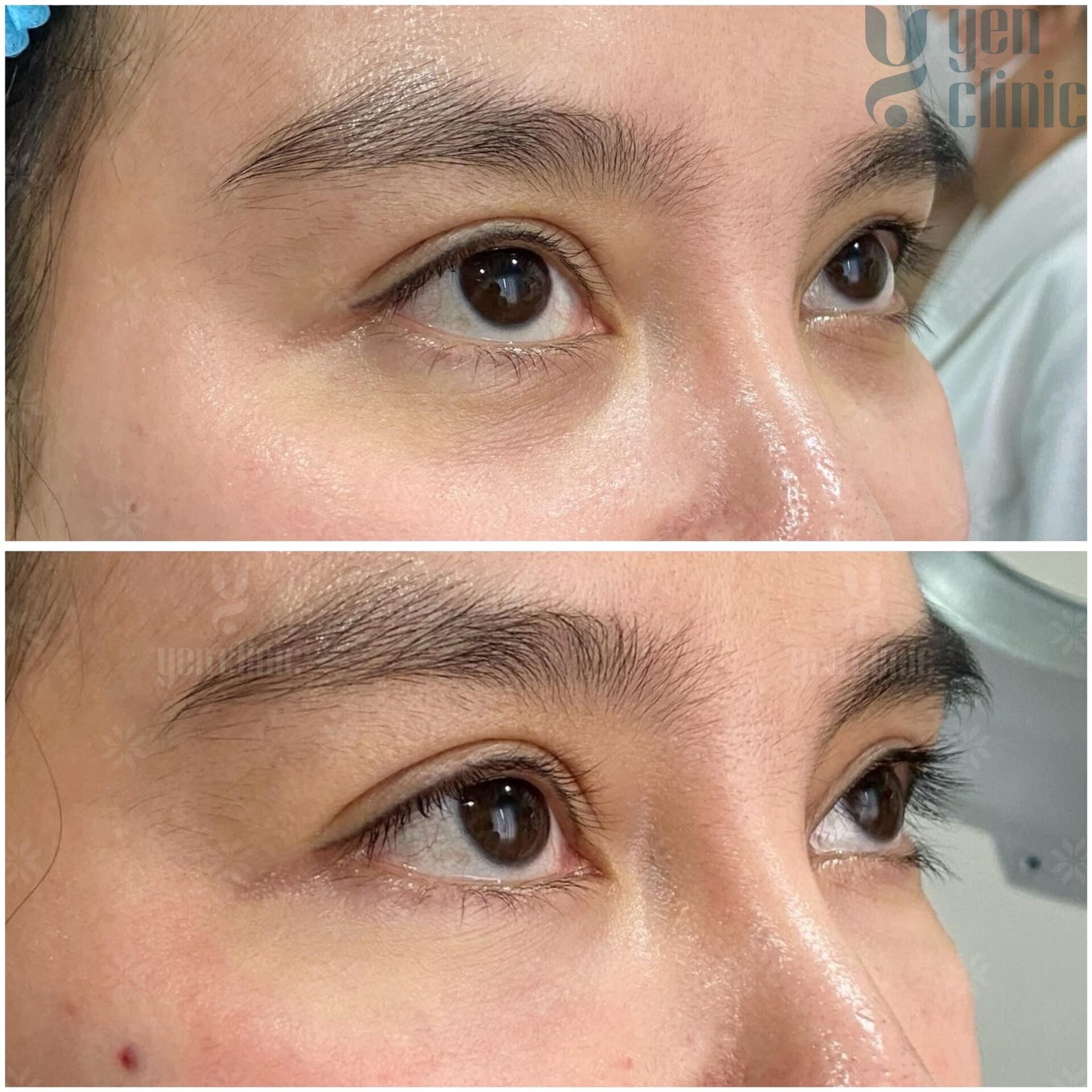
Jawline filler and masseter Botox both make the lower face look neater without surgery, but they fix opposite problems. Filler adds volume at the jaw angle, jaw border and chin so the line looks sharper. Botox shrinks the chewing muscle when the jaw looks square because of it. The right choice depends on the cause.
Key points
- Filler adds what is missing (a soft jaw angle, a dip along the jaw border, a short chin). Botox reduces what is too much: a large masseter muscle.
- Quick self-check: clench your teeth and feel just in front of the ear. A firm bulge that pops up means the muscle is part of the width.
- Jawline filler shows straight away. In the study behind the first FDA approval of a jawline filler, about 61% of people were still improved at 12 months.
- Masseter Botox takes a few weeks to slim the jaw, peaks around month 3 and usually lasts 6–12 months.
- Fat under the chin and sagging skin are not fixed by filler or Botox. They need other options such as HIFU, threads or liposuction.
What do jawline filler and masseter Botox actually do?
“Jawline injections” covers two very different treatments:
- Jawline filler: the doctor places a dermal filler, usually hyaluronic acid (HA), at a few points along the jaw angle, the jaw bone and the chin. It adds volume where it is lacking so the jawline runs as one clean line from below the ear to the chin.
- Masseter Botox: botulinum toxin is injected into the masseter, the chewing muscle at the angle of the jaw. The muscle works less and gradually shrinks, so a square lower face slims down.
If your jaw is square because the masseter is large, filler at the jaw angle makes the face look wider. If your jawline is soft because of lost volume, Botox changes almost nothing. That is why the doctor needs to find the cause before choosing the product.

What does a good jawline look like?
There is no single template. A jawline that reads as attractive usually has:
- A continuous jaw border from the angle below the ear to the chin, without a dip in the middle or sagging beside the chin.
- A visible jaw angle that is in proportion with the cheekbones and forehead. Studies measuring X-rays put the average adult jaw (gonial) angle at around 120–130 degrees, with very small differences between men and women; one study found no difference at all.
- A chin that is long and projected enough. A short or retruded chin blurs the whole jawline even when the jaw angle is fine.
- A clear jaw-to-neck transition, not hidden by fat under the chin or loose skin.
The jaw bone also changes with age. A 2026 review of facial bone ageing reports that the jaw angle widens by 3–7 degrees, and that men show more pronounced remodelling of the jaw. This is one reason the jawline softens after 40, even without weight gain.
A razor-sharp “snatched” jaw is not the goal for everyone. For many Asian women, a soft, continuous jawline that balances the chin looks more natural than a square angle pushed outwards.
Why does a jaw look wide or soft?
This is the part that decides what to inject, or whether to inject at all.
| Cause | How to check in the mirror | Usual approach |
|---|---|---|
| Large masseter muscle | Clench your teeth and feel in front of the ear: a firm bulge appears; you often grind or chew hard food | Masseter Botox |
| Short or retruded chin | In profile, the chin sits behind a vertical line dropped from the lower lip | Chin filler; surgery for marked cases |
| Lost volume along the jaw, soft jaw angle | In profile the angle is hard to see; the jaw border has a dip | Jawline filler |
| Fat under the chin (double chin) | You can pinch soft fat under the chin; the jaw-neck line disappears when you look down | Liposuction under the jaw or other fat-reduction options |
| Loose skin, jowls | Lifting the cheek skin gently brings the jawline back; usually after 35–40 | HIFU, threads, sometimes a little filler; a facelift for marked laxity |
| Wide jaw bone from birth | The jaw is wide but no muscle bulge appears on clenching; it has always been that way | Filler and Botox cannot change bone; a surgical opinion is needed |
Many people have two or three causes at once. A common example is a large masseter plus a short chin: Botox for the muscle and filler for the chin usually gives a more balanced result than doing only one.
Jawline filler is not the same as chin filler. Chin filler lengthens or projects the chin. Jawline filler works along the jaw angle and jaw border. A soft jawline is often partly a chin problem, which is why the two are frequently planned together.
When is jawline filler the right choice?
Filler suits a jawline that looks soft because of missing volume: an undefined jaw angle, a dip along the jaw border in front of the jowl area, a short chin. The aim is a continuous line, not a bigger jaw.
Where the doctor injects. Common points are the jaw angle, the body of the jaw, the hollows in front of and behind the jowl area, and the chin. A technique review divides the jawline into three zones (masseteric, buccal and mental), each with its own injection approach and safety points. It also recommends small volumes per injection point for a natural result and fewer serious complications.
Which filler. The jaw needs a firm, supportive product: a high-G′ (stiffer) HA or calcium hydroxylapatite (CaHA). HA has the advantage that it can be dissolved with hyaluronidase if it needs adjusting or a complication occurs. CaHA cannot be dissolved this way.
The evidence. In 2022 the US FDA approved Juvéderm Volux XC, the first HA filler indicated to improve jawline definition, for adults over 21 with moderate to severe loss of jawline definition. In the pivotal study (157 people treated, 49 untreated controls), the share of people rated as improved in the observed data was:

- 69.9% at month 6, versus 39.1% of the untreated group.
- 61.3% at month 12.
- The median volume was 4.35 mL for the first treatment and 2.0 mL for a touch-up. The total ranged widely, from 1.0 to 9.3 mL.
Participants were 26 to 81 years old, with a median age of 59, so most had a jawline softened by ageing. Younger people who only want a slightly sharper jaw usually need less. The exact amount can only be judged at a consultation.
At Yen Clinic, authentic fillers are chosen by area and the doctors, Dr Diep Yen Linh and Dr Diep Yen Nhi, inject in person. See dermal fillers at Yen Clinic.
When is masseter Botox the right choice?
Botox suits a square lower face caused by a well-developed masseter, which is common in people who grind their teeth or chew a lot of tough food. The toxin makes the muscle contract less, so it gradually shrinks and the lower face slims.
A review of masseter Botox in Asian patients reports that the muscle starts to slim after 2–4 weeks and the effect can last up to 12 months. Another review of 14 studies found the maximum effect is usually seen about 3 months after one session and lasts 6–12 months. Clinic websites often quote 3–6 months; how long it lasts varies with the dose and the person. Repeat sessions are needed to keep the result.
Points worth knowing:
- It is off-label. No country has approved botulinum toxin specifically for slimming the masseter, although the treatment is very popular in Asia. Doctors choose the dose from experience and published studies.
- The dose is individual. Reviews state there is no standard dose, and doses are not interchangeable between botulinum toxin brands.
- It does not shrink the bone. A placebo-controlled study of 187 people measured the width between the jaw angles, bone thickness and the jaw angle, and found no difference between the treated and placebo groups. The change is in the muscle, not the bone.
- For teeth grinding and jaw joint pain, a 2026 review of 15 trials concluded Botox should not be a first-line treatment, but can be an add-on for people who have not improved with other options.
- Like all botulinum toxin products, the US label carries a boxed warning that the effect can spread beyond the injection site and, rarely, cause swallowing or breathing difficulties. This is one reason dosing and placement should be done by a doctor.
Yen Clinic uses Xeomin by Merz (Germany). More detail on doses, repeat sessions and other areas is on the Botox page and in What is Xeomin?
Jawline filler vs Botox at a glance
| Jawline filler | Masseter Botox | |
|---|---|---|
| What it does | Adds volume and definition at the jaw angle, jaw border and chin | Shrinks the masseter muscle |
| Best for | Soft jawline, undefined angle, short chin, dip along the jaw | Square jaw from a large masseter, teeth grinding |
| When you see it | Immediately; settles once swelling goes down | After 2–4 weeks, best around month 3 |
| How long it lasts | Depends on the product; Volux study: 61.3% still improved at 12 months | Usually 6–12 months |
| Reversible? | HA filler can be dissolved with hyaluronidase | No; you wait for it to wear off |
| Main risks | Swelling, bruising, lumps; rare but serious: vascular occlusion | Chewing fatigue, hollow cheeks, an unnatural smile |
Can you combine filler and Botox?
Yes, and many people need both, for example Botox for a large masseter and filler for a short chin or a dip along the jaw. Both can be done on the same day or in stages, depending on the assessment.
Doing it in stages is often more precise. Botox takes weeks to slim the muscle and peaks around month 3, so the jaw looks different once it has worked. Reassessing filler after the muscle has slimmed means you are less likely to have more filler than you need.
Two mistakes to avoid:
- Filler on a jaw that is already wide from muscle. Adding volume at the angle makes the face heavier and squarer.
- Botox when the real problem is sagging skin. A review of masseter Botox notes that sagging can follow a rapid loss of muscle volume. If the jawline is soft because of laxity, slimming the muscle can make jowls look more obvious.
A real case at Yen Clinic
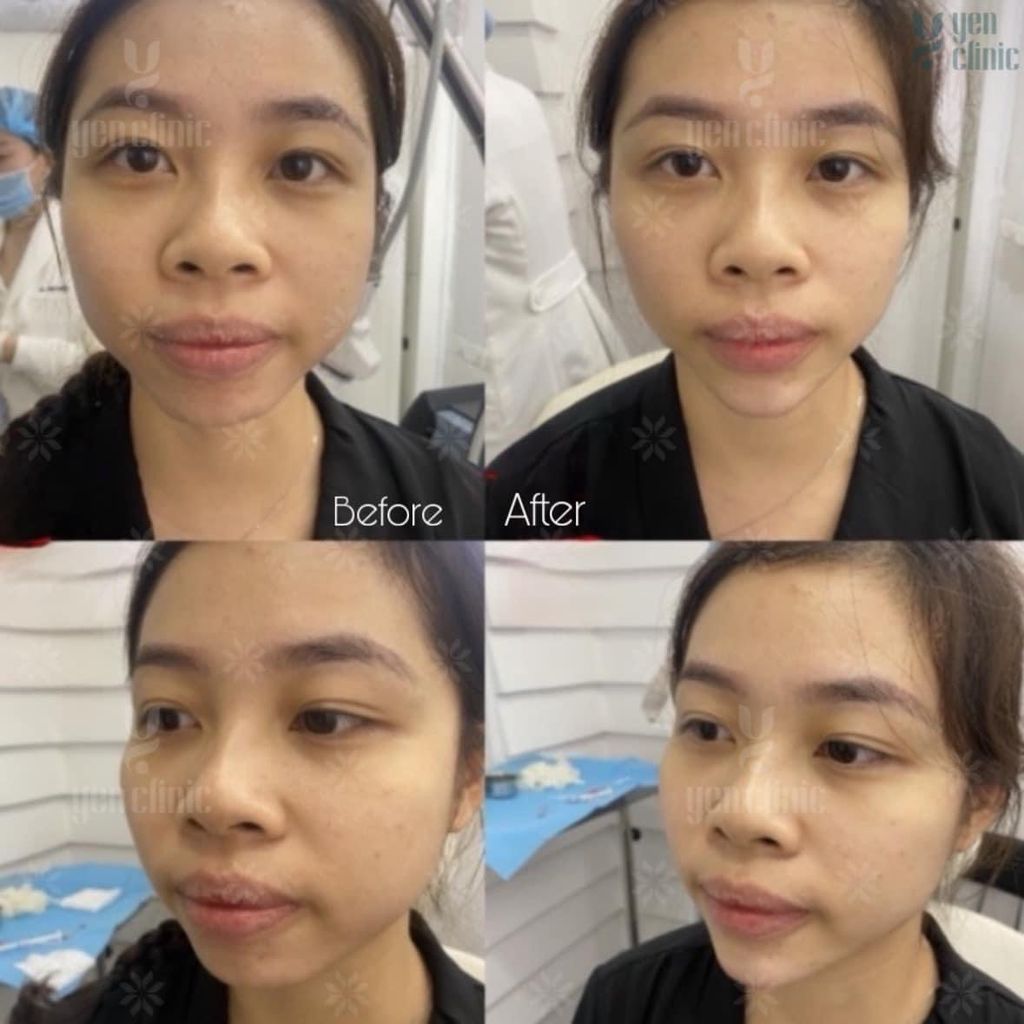
This client had a short chin and an undefined jawline. The doctor injected filler to rebalance the chin and jawline, and the shape of the lower face changed straight after the session.
What happens at a jawline filler or Botox appointment?
- Assessment and photos. The doctor looks at your face from the front and in profile, at rest and while you clench, feels the masseter, and checks the chin, fat under the chin and skin laxity. This decides between filler, Botox, both, or something else.
- Cleansing and numbing. For filler, the area is usually numbed; many fillers also contain lidocaine.
- Injection. Filler can be placed with a fine needle or a cannula (a blunt-tipped tube), in small amounts per point. Botox is injected at a few points in the lower part of the masseter.
- Review. You see the early result with filler, get aftercare instructions and a follow-up date for review and touch-up if needed. In one published case series, patients were observed in the clinic for 20–30 minutes after filler to watch for signs of vascular problems.
Visiting Ho Chi Minh City from abroad? Book the treatment early in your stay and schedule the review before you fly home. In the Volux study, most injection-site reactions (tenderness, lumps, swelling, bruising) resolved within 2 weeks, so leaving about two weeks gives time to check the result and touch up if needed.
Is jawline filler risky?
Most side effects are mild and short-lived. In the Volux study, the most common reactions after the first treatment were tenderness to touch (80.1%), lumps or bumps (79.1%), pain after injection (78.1%), swelling and bruising. Most were mild or moderate and resolved within 2 weeks. About 2% of people had some difficulty chewing, which settled within 3 days.
The rare but serious risk with filler is vascular occlusion: filler entering or compressing a blood vessel and cutting off blood supply to the skin. An anatomy review stresses that there are no completely safe zones on the face. In a review of 365 cases of vision loss after filler, the highest-risk sites were the nose, forehead and the area between the brows. The jawline is not in that group, but the risk is not zero. Call your doctor straight away if you notice:
- Skin at the injection site turning white, then a dusky purple, net-like pattern. This is easy to mistake for a bruise.
- Pain that gets worse instead of better.
- Blurred vision or any change in eyesight.
Occlusion can appear during the injection or later. Speed matters. With HA filler, the doctor uses hyaluronidase to dissolve it, which is why it is worth choosing a clinic where a doctor injects and the reversal drug is on hand.
With masseter Botox, reported side effects include temporary chewing weakness or fatigue, hollow cheeks (seen more often in Asian patients), slight sagging when the muscle shrinks quickly, and an unnatural smile if the toxin reaches the smile muscle. A review of 36 papers found most complications appeared in the first 2–4 weeks and resolved within 12 weeks.
Who should not have jawline filler or Botox?
Filler: according to FDA information for Volux XC, it should not be used in people with severe allergies with a history of anaphylaxis, an allergy to lidocaine or to gram-positive bacterial proteins, or a bleeding disorder.
Botox: according to the drug label, it should not be used if you are allergic to any botulinum toxin product or if the injection site is infected. People with neuromuscular conditions such as myasthenia gravis or Lambert-Eaton syndrome are at higher risk of serious side effects. Tell the doctor if you are taking aminoglycoside antibiotics, which can strengthen the effect of the toxin.
Pregnancy and breastfeeding: there is not enough safety data, so treatment is usually postponed.
Tell your doctor about all medicines you take, especially blood thinners and aspirin, and any previous filler or Botox.
Before and after: practical tips
- Tell the doctor which medicines and supplements you take; they will advise whether any should be paused before treatment.
- If you have an important event, have the treatment a few weeks before so swelling and bruising (filler) can settle or the effect (Botox) can build.
- Afterwards, avoid firm massage of the treated area and follow your doctor’s advice about exercise and saunas for the first few days.
- Come back straight away if you notice the warning signs above, or increasing swelling, pain, fever or difficulty opening your mouth.
Do jaw exercises or weight loss work instead?
Facial exercises, chewing gum and “mewing” are popular on social media, but there are currently no studies showing they change the shape of the jawline.
Weight loss helps when the face is round because of fat, especially under the chin. It changes little if the width comes from muscle or bone, or if the jawline is soft because of loose skin.
Once the skin sags, filler is not enough. Adding filler to a sagging jawline can make the face look heavier. Doctors then consider lifting and tightening options such as HIFU and thread lifts (see skin rejuvenation), liposuction under the jaw for a double chin, or a facelift in marked cases.
How much does jawline filler cost in Vietnam?
The cost depends on the approach (filler, Botox or both), the amount of filler in mL, the product, and any touch-up visits. Because the amount of filler varies so much between people, an accurate quote is only possible after an examination. For a double chin, liposuction under the jaw at Yen Clinic costs 35,000,000 VND, about US$1,350 at Vietcombank’s selling rate of 25,990 VND per dollar on 23 November 2026 (price list).
Frequently asked questions
How long does jawline filler last?
It depends on the product. In the study behind the FDA approval of Volux XC, 61.3% of people were still rated as improved at 12 months, and a maintenance treatment a year later used less than half the original volume. Masseter Botox usually lasts 6–12 months.
Is 1 mL of filler enough for the jawline?
Sometimes, for a small correction such as defining the jaw angle or the chin. In one case series of women aged 42–71, typical amounts were 0.3–0.5 mL at the jaw angle and 0.5–1 mL along the body of the jaw, and full lower-face reshaping used 4–7 syringes. In the Volux study the median first treatment was 4.35 mL. So 2–3 mL is not unusual for the jawline, but more is not automatically better.
Can jawline filler make my face look bigger?
Yes, if it is used on the wrong face or in excess. Filler at the angle of a jaw that is already wide from a large masseter makes the face look wider. Filler should be used for a jaw that lacks definition, in an amount that stays in balance with the chin and cheekbones.
What happens if I stop masseter Botox?
As the toxin wears off, the masseter works again and gradually returns to how it was before treatment, so keeping the result needs repeat sessions. Botox acts only on the muscle: a placebo-controlled study found it did not change the jaw bone.
Can men get jawline filler?
Yes. Men usually want a more defined, squarer jaw angle, so the placement and amount differ from women. Men with a wide jaw from a large masseter can have Botox, but should think about it if they want to keep a strong jaw angle.
Does jawline filler hurt?
You feel pricks and pressure during the injection. The area is usually numbed and many fillers contain lidocaine. Afterwards you may feel tender, swollen or bruised for a few days to about two weeks.
Sources: FDA: Juvéderm Volux XC – P110033S065 (approval page) and Summary of Safety and Effectiveness Data (SSED, 2022). Kundu N et al. J Cosmet Dermatol 2022 (PMID 35176198). Wu Y, Zeng D, Wu S. Aesthet Surg J Open Forum 2023 (PMC10045881). Yeh YT et al. J Cosmet Dermatol 2018 (PMID 30091170). Mallya SM et al. Aesthet Surg J 2026 (PMC13773675). Ronconi G et al. Toxins 2026 (PMC13709608). Moradi A et al. Facial Plast Surg 2019 (PMID 30943558). Rauso R et al. Dermatol Pract Concept 2022 (PMC9464529). Lowe S. J Cosmet Dermatol 2026 (PMC13144706). Isaac J et al. JPRAS Open 2022 (PMC10102405). Doyon VC et al. Aesthet Surg J 2024 (PMID 38630871). Lee KWA et al. JPRAS Open 2026 (PMC12914125). Arthanari A et al. Cureus 2024 (PMC11031626). Belaldavar C et al. J Forensic Odontostomatol 2019 (PMC6981352). BOTOX Cosmetic prescribing information (DailyMed). Vietcombank exchange rate, 23 November 2026.