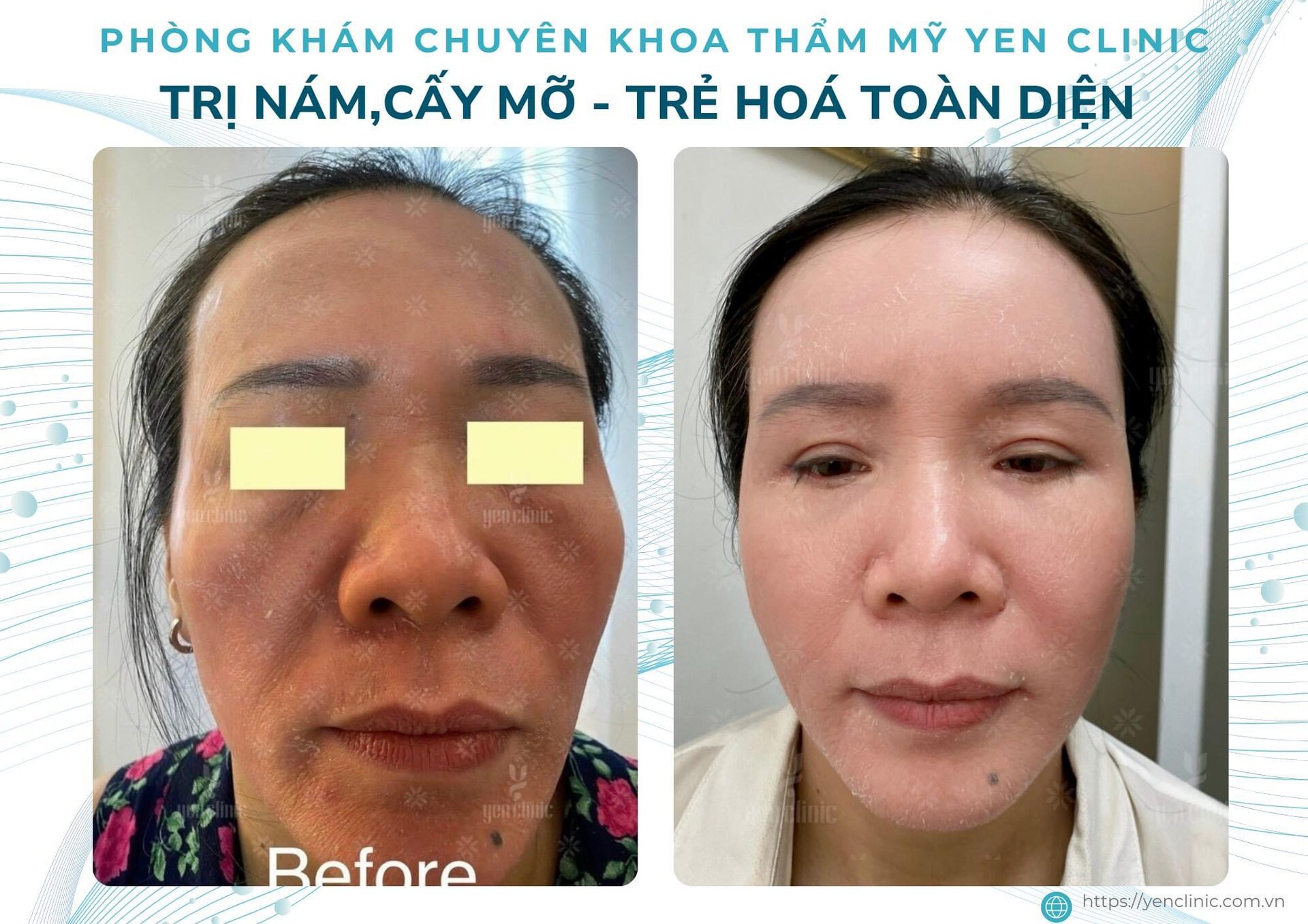
Yes, lasers can lighten freckles, often clearly after one or two sessions, and pigment lasers are the most effective option. But no treatment removes freckles for good. Sun exposure makes old freckles darken again and new ones appear, so sun protection matters as much as the laser.
Key points
- Freckles are small, flat, light-brown spots that darken in sunny months and fade when you get less sun. They are not the same as melasma, sun spots or post-acne marks, and each needs a different treatment.
- Pigment lasers (532 nm, ruby, Q-switched, picosecond) work best. In a 2026 trial of 84 people, almost everyone’s freckles lightened after one session, but only about 1 in 10 cleared completely.
- Expect the treated freckles to darken and form a fine crust that usually flakes off within about a week on the face.
- Prices in Ho Chi Minh City: about VND 1–3 million (US$38–115) per session at the public dermatology hospital; at Yen, pigment laser starts from VND 5 million (about US$192) per session.
- US dollar figures use the Vietcombank selling rate of VND 25,990 per US$1 on 23 November 2026, rounded.
What freckles are
Freckles (ephelides) are small light-brown or tan marks on sun-exposed skin such as the nose, cheeks, shoulders and arms. DermNet describes them as 3–10 mm across, prominent in summer and fading in winter.
In a freckle the number of pigment cells does not increase; the existing cells simply produce more melanin when exposed to UV light. That is why freckles multiply and darken after time in the sun. Genes play a large part: people with many freckles carry a variant of the MC1R gene, and in people who are not of European descent a different variant of the same gene is involved.
Freckles are harmless. DermNet notes that no treatment is necessary; most people treat them for cosmetic reasons.
Freckles, melasma, sun spots or post-acne marks?
Getting this right decides which laser to use and whether the result will last.

| Freckles | Melasma | Sun spots (solar lentigo) | Post-acne marks | |
|---|---|---|---|---|
| Look | Small, round, even-coloured dots with clear edges, scattered | Large, blotchy patches with soft, irregular edges | Larger, flat, darker spots with clear edges | Reddish-brown marks where pimples were |
| Who | From childhood, lighter skin, often runs in families | Adult women, linked to hormones | Middle age onwards, years of sun | After inflamed acne or squeezing spots |
| Seasons | Darker in sunny months, lighter otherwise | Worse with sun, heat, hormonal changes | Present all year, slightly darker in summer | Fade over months |
| Main approach | Pigment laser, sun protection | Combination of creams, low-energy laser, injectables; often recurs | Pigment laser, cryotherapy, creams | Creams, peels, time; treat the acne first |
Many people have freckles and melasma on the same face. A strong laser setting suitable for freckles can make melasma worse, so the doctor examines the skin and treats each area with its own settings. Read more on our melasma and pigmentation treatment page.
Which laser is best for freckles?
Pigment lasers emit light at wavelengths that melanin absorbs strongly. The energy breaks up the pigment in the freckle, and the body clears it over the following weeks, with less effect on surrounding skin.
| Device | Wavelength | Good for | Notes for Asian skin |
|---|---|---|---|
| Q-switched 532 nm (KTP / frequency-doubled Nd:YAG) | 532 nm | Freckles, superficial brown spots | Effective for shallow pigment; settings must be adjusted to limit dark marks after laser |
| Ruby laser | 694 nm | Freckles, brown spots | Strongly absorbed by melanin |
| Picosecond laser | 532, 730, 755 or 1064 nm depending on the device | Freckles, sun spots | Ultra-short pulses, less heat |
| Q-switched alexandrite | 755 nm | Freckles, sun spots | Compared with IPL in Asian patients |
| IPL (intense pulsed light) | Broad spectrum | Light freckles, uneven tone | Not a laser; usually needs more sessions |
What the studies show
- A split-face trial in Taiwan (Wang and colleagues, 2006) compared one Q-switched alexandrite session on one cheek with two IPL sessions on the other. Freckles improved more on the laser side. Dark marks after treatment (post-inflammatory hyperpigmentation) occurred in 1 of 15 people with freckles, but in 8 of 17 people with sun spots.
- A 2026 multicentre trial in China (Zhou and colleagues) treated 84 people with one session of a 532 nm picosecond laser. At 8 weeks, 97.6% responded, yet only about 10–13% were completely clear.
- A small 2019 study of 12 people with Fitzpatrick skin types III–IV found picosecond laser effective for freckles and sun spots with a low risk of dark marks.
- A 2025 systematic review of trials for sun spots reported success rates of 67.9–93.02% for picosecond lasers, compared with 36.36–76.6% for Q-switched lasers.
At Yen, doctors use 532 nm and ruby lasers for freckles and brown spots, choosing the device and energy according to how dark the spots are, your skin tone, and whether melasma is also present.
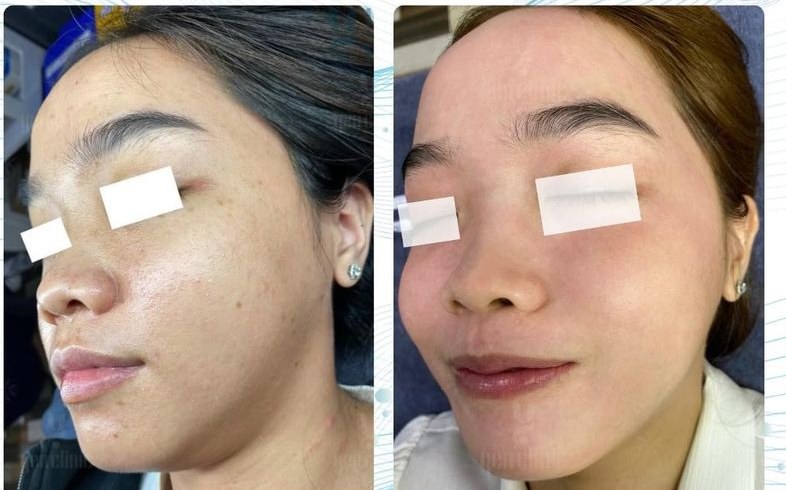
Is laser for freckles safe for darker skin?
The American Academy of Dermatology (AAD) notes that lasers can be used on all skin types, but darker skin is more prone to burns and dark marks after laser treatment. Choose a doctor experienced in treating skin of colour with lasers.
What happens after treatment: day by day
Timings below are typical for freckles on the face; your doctor will tell you what to expect for your skin.

- During treatment: a quick snapping sensation, like a rubber band. Numbing cream can be used for larger areas.
- First hours: mild redness and warmth.
- Days 1–2: treated freckles turn darker.
- Days 3–7: a very fine crust forms over each spot. Do not pick it.
- Around one week: the crusts flake off on the face; areas such as the arms and shoulders take longer.
- 2–4 weeks: the new skin may stay slightly pink; this is when the result is assessed and the next session, if needed, is planned.
Most people go back to work the next day. Make-up can usually be used once the crusts have come off.
How many sessions?
Light freckles often lighten clearly after one or two sessions, about four weeks apart. Darker or denser freckles, or freckles mixed with melasma, need more. Freckles usually need fewer sessions than melasma, especially deep melasma.
How much does freckle removal cost?
The cost depends on the device, the area and the number of sessions. The public Ho Chi Minh City Hospital of Dermato-Venereology publishes its prices (per session, checked 23 November 2026):
| At the public dermatology hospital | VND | Approx. US$ |
|---|---|---|
| Freckles with IPL, 20–40 pulses | 2,000,000 | 77 |
| Freckles with IPL, 40–70 pulses | 3,000,000 | 115 |
| Freckles with Clarity laser, 5–10 cm² | 1,000,000 | 38 |
| Freckles with Clarity laser, 10–20 cm² | 2,000,000 | 77 |
| Freckles with Clarity laser, 20–30 cm² | 3,000,000 | 115 |
| Freckles with Q-switched laser, face, from session 3 | 2,400,000 | 92 |
| Brown spots with picosecond laser, under 5 cm² | 500,000 | 19 |
At Yen Clinic, pigment laser for freckles and brown spots starts from VND 5,000,000 (about US$192) per session. The doctor examines your skin, checks for melasma, and then gives you a quote and the expected number of sessions. See melasma and pigmentation treatment at Yen for how treatment is planned.
Will freckles come back?
Laser breaks up existing pigment but does not change your genes or stop your pigment cells reacting to future sun. DermNet describes the result of pigment laser as a temporary lightening, and notes that freckles increase after UV exposure. To keep results:
- Use sunscreen every day. The AAD recommends SPF 30 or higher, broad-spectrum (UVA and UVB) and water-resistant, applied about 15 minutes before going outside and reapplied every two hours, or straight after swimming or sweating. DermNet suggests SPF 50+ for freckled skin.
- Cover up: a wide-brimmed hat, sunglasses and shade in the middle of the day.
- Time your treatment for a period with less sun and fewer beach trips.
- Maintain with creams your doctor prescribes after the laser course.
If you are visiting Ho Chi Minh City
- One session fits a short stay, but plan around the crusting week: avoid beach days and strong sun.
- The US CDC Yellow Book, citing the American Society of Plastic Surgeons, recommends waiting 7–10 days after laser or cosmetic procedures to the face before flying.
- Book with your travel dates; the booking form accepts WhatsApp, Viber, Messenger or email.
When to see a doctor instead
Most brown spots are harmless, but see a dermatologist about any spot that looks different from the others, is changing in size, shape or colour, or itches or bleeds. These are signs the AAD lists for checking skin cancer. Never laser or burn off a spot that has not been examined.
Frequently asked questions
Does laser remove freckles permanently?
No. Laser can make freckles much lighter, and many spots become hard to see, but new or returning freckles are common without strict sun protection.
Can pico laser remove freckles?
Picosecond lasers are effective for freckles and sun spots, and studies in Asian skin show good lightening with a low risk of dark marks. Most freckles still need sun protection afterwards to stay light.
How much does it cost to remove a freckle?
Some clinics charge per spot for a few freckles and per session for a whole face. Prices in Ho Chi Minh City range from about VND 0.5–3 million (US$19–115) per session at the public hospital; at Yen, from VND 5 million (about US$192) per session.
Can I use creams instead of laser?
Creams with retinoids, hydroquinone or vitamin C can lighten dark spots slowly and help maintain results, but they work more slowly than laser. Avoid “fast-whitening” creams of unknown origin: the AAD warns that steroids or mercury not listed on the label have been found in some imported skin care products.
Can I have freckle laser while pregnant?
It is usually best to wait until after pregnancy and breastfeeding, and to avoid retinoid and hydroquinone creams. Daily sun protection is the safest way to stop freckles darkening during pregnancy.
References
- DermNet. Ephelis (freckle). dermnetnz.org/topics/ephelis.
- DermNet. Solar lentigo. dermnetnz.org/topics/solar-lentigo.
- Wang CC, Sue YM, Yang CH, Chen CK. A comparison of Q-switched alexandrite laser and intense pulsed light for the treatment of freckles and lentigines in Asian persons. J Am Acad Dermatol. 2006. doi:10.1016/j.jaad.2006.01.012.
- Zhou Y, Bao Y, Fu Y. J Dermatolog Treat. 2026. doi:10.1080/09546634.2026.2702775.
- Lasers Surg Med. 2019. PMID 30357871.
- Treatment of solar lentigines: a systematic review of clinical trials. J Cosmet Dermatol. 2025. PMID 40145274.
- American Academy of Dermatology. Skin conditions lasers can treat. aad.org/public/diseases/a-z/skin-conditions-lasers-treat.
- American Academy of Dermatology. How to apply sunscreen. aad.org/public/everyday-care/sun-protection/shade-clothing-sunscreen/how-to-apply-sunscreen.
- American Academy of Dermatology. Sunscreen FAQs. aad.org/public/everyday-care/sun-protection/shade-clothing-sunscreen/sunscreen-faqs.
- American Academy of Dermatology. 5 ways to fade dark spots. aad.org/public/everyday-care/skin-care-secrets/routine/fade-dark-spots.
- American Academy of Dermatology. ABCDEs of melanoma. aad.org/public/diseases/skin-cancer/abcdes-melanoma.
- Centers for Disease Control and Prevention. CDC Yellow Book: Medical tourism. cdc.gov/yellow-book/hcp/health-care-abroad/medical-tourism.html.
- Ho Chi Minh City Hospital of Dermato-Venereology. Service price list. bvdl.org.vn/cong-dong/bang-gia-dich-vu (accessed 23 November 2026).