Punch excision is a treatment for acne scars in which a small round hole is cut around the scar and the surrounding skin is then stitched closed. This removes the deep scar tissue and replaces it with a new wound that is smaller and flatter, making the acne scar less visible.
The method is usually used for depressed acne scars and small, deep acne scars, and is often combined with other methods for the best result. For wide or shallow scars, punch excision is usually not the first choice; the doctor will suggest laser, subcision or volume filling instead.
Quick summary
- Punch excision uses a round punch tool (about 1–12 mm in size) to remove the scar completely, followed by stitching, elevation or a skin graft.
- Best suited to ice-pick scars and deep boxcar scars; not suitable for undulating rolling scars.
- How it differs from subcision: subcision removes no skin; it only cuts the fibrous bands beneath the scar.
- Done under local anaesthetic; you can usually carry on as normal afterwards; mild swelling and bruising last about 1–2 weeks.
- Rarely done on its own: usually combined with laser, chemical peels, subcision and volume filling in the same treatment plan.
How does punch excision work?
The doctor uses a small cylindrical instrument called a punch, which works like a round cutter. Punches come in several sizes, from about 1 to 12 mm, and one is chosen to fit the width of the scar exactly. After a local anaesthetic, the doctor removes all of the scar tissue and then deals with the defect in one of three ways:
| Technique | What is done | Used for |
|---|---|---|
| Punch excision (cutting out) | The scar is removed and the skin edges are stitched into a small line | Ice-pick scars, small and deep boxcar scars |
| Punch elevation (lifting) | The base of the scar is cut around, lifted level with the skin surface and secured, keeping the scar edges in place | Wider boxcar scars where the scar base looks normal |
| Punch grafting (grafting) | The scar is removed and a small piece of healthy skin (usually taken from behind the ear) is placed in the defect | Very deep or wide scars that cannot be stitched in a straight line |
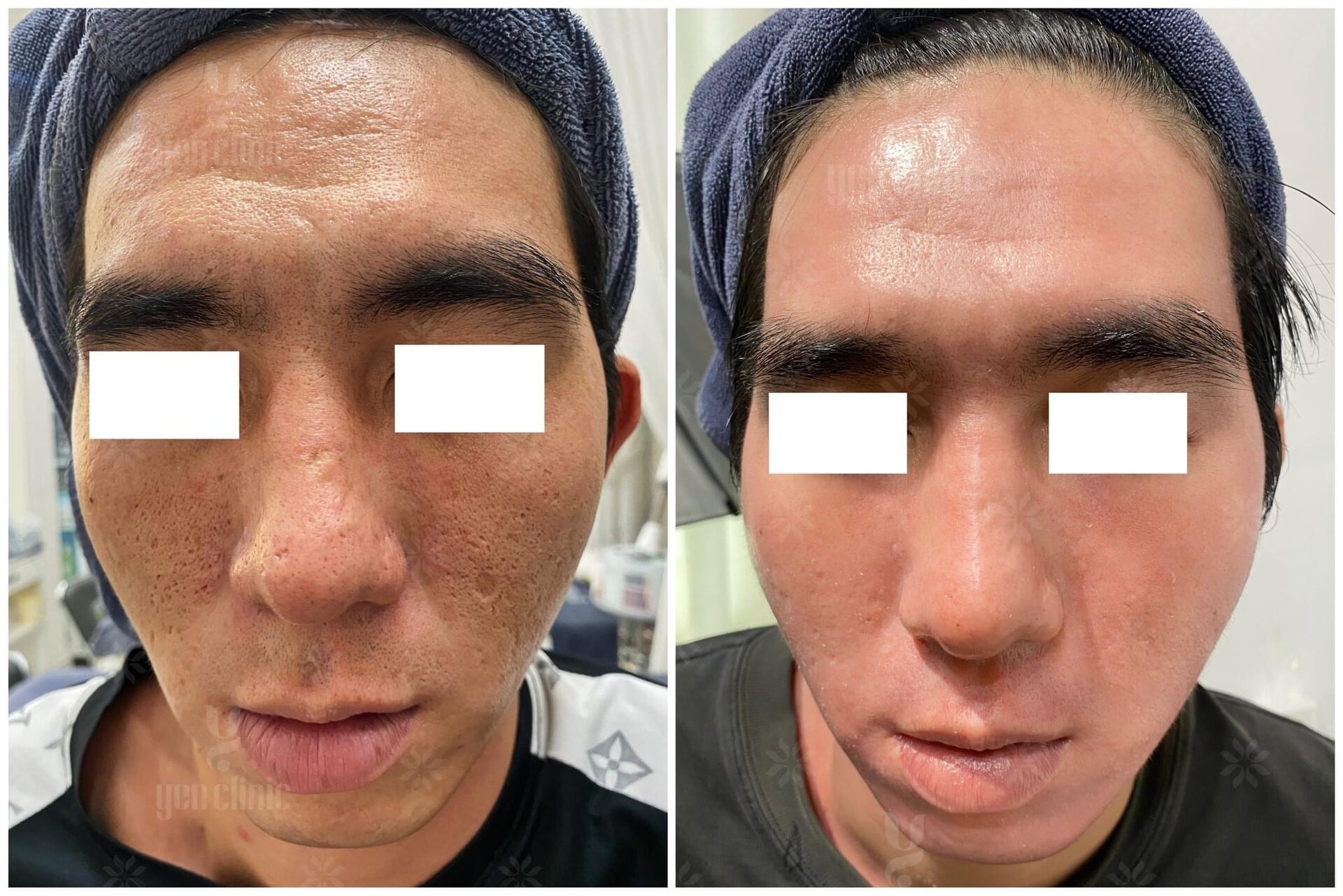
Once healed, the new mark is usually flatter, finer and easier to conceal than the old depressed scar, especially when the surface is smoothed further with laser or a chemical peel.
Which acne scars is punch excision suited to?
Acne scars come in three main types. According to DermNet, ice-pick scars are the most common type, making up about 60–70% of depressed scars: a narrow opening, deeper than they are wide, V-shaped and reaching into the deep dermis. They are also the type whose base laser finds hardest to reach.
| Scar type | How to recognise it | Is punch excision suitable? |
|---|---|---|
| Ice-pick scars | Small opening, deep like a pinprick | Best suited: punch excision |
| Boxcar scars | Steep walls and a flat base, clearly visible when light casts a shadow | Suited to deep boxcar scars: excision or elevation. For shallow boxcar scars, laser is preferred |
| Rolling scars | Undulating surface caused by fibrous bands pulling the skin down | Not suitable: these need subcision and volume filling |
One face often has all three types at once, so the doctor examines and marks each scar individually rather than punching them all in one go.
How is punch excision different from subcision and “scar base cutting”?
These three names are often used interchangeably, but they are three different things:
- Punch excision: the scar is removed completely with a punch tool and then stitched, elevated or grafted.
- Subcision: no skin is removed; the doctor passes a needle or cannula under the scar to cut the fibrous bands that are pulling the scar base down, allowing the skin to lift. Suited to rolling scars.
- “Scar base cutting”: a term commonly used online, usually meaning subcision, sometimes including punch excision as well. At your consultation, ask the doctor exactly which technique will be used on which scar.
Why punch excision is usually combined with other methods
Punch excision only deals with small, deep scars. The rest of the scarred skin still needs treatment. At Yen Clinic, an acne scar treatment plan may include:
- Subcision for scars pulled down by fibrous bands.
- DEKA ablative CO2 laser, TCA CROSS to smooth the surface and the scar edges.
- Volume filling with your own fat, filler or PRF.
- Punch excision, scar revision surgery for scars that do not improve with the methods above.
The order matters a great deal. In one case Yen has shared, the doctor scheduled scar excision and stitching in the near-final phase of the course of treatment, once the scars that respond to laser had improved and the skin was clear of inflammation. Read this case.
Who should consider punch excision, and who should wait?
Consider it if:
- You have ice-pick or deep boxcar scars that are clearly visible even with make-up.
- You have had laser or chemical peels many times and the deep scars still have not filled in.
- Your acne is under stable control.
Hold off, or have a careful assessment by the doctor first, if:
- You have inflammatory acne or an infection in the area to be treated.
- Your scars are mainly rolling, undulating scars: subcision and volume filling work better.
- You are prone to keloids or hypertrophic scars.
- You are taking or have recently taken isotretinoin, or are on anticoagulants: tell your doctor so the timing can be planned appropriately.
Preparing for punch excision
- Tell your doctor about any medicines and supplements you take and any history of keloids.
- Do not squeeze spots or use strong exfoliation on the scarred area in the days before the procedure.
- Plan your schedule so you can avoid the sun and keep the wound clean during the first week.
- Take photos of the scarred area under angled light to compare before and after.
The punch excision process at Yen Clinic
- Examination and marking: the doctor looks at each scar under angled light, chooses the scars suitable for punching, and explains the treatment plan and the cost.
- Preparing the skin: acne and inflammation are brought under control before any procedure. Inflamed skin is more likely to heal poorly and develop hyperpigmentation.
- Anaesthetic and punching: after a local anaesthetic, the doctor chooses a punch size to fit the scar and then performs punch excision, elevation or grafting.
- Stitching and dressing: the wound is closed with fine sutures and dressed.
- Follow-up: the stitches are checked and removed, and the surface-smoothing steps are then scheduled if needed.
The procedure is performed by the doctor personally, not delegated to a technician.
After punch excision: what is recovery like?
- The discomfort is mainly during the anaesthetic injection. Once the anaesthetic wears off, the area may feel a little sore for a few days.
- Keep the wound clean and dry as instructed; keep direct sun off the treated area.
- Mild swelling and bruising may last about 1–2 weeks. Complete healing takes a few months, during which the new mark gradually fades.
- Most people can carry on as normal after the procedure; the doctor will advise on the exact time off depending on the number and location of scars.
Advantages and limitations of punch excision
| Advantages | Limitations |
|---|---|
| Removes the deep scar tissue that laser and chemical peels struggle to reach | Leaves a new mark (a small stitch line or a graft) that needs time to fade |
| A minor procedure needing only local anaesthetic | Only suited to small, deep scars; cannot treat rolling scars or wide areas of shallow scarring |
| You can usually carry on as normal afterwards | Swelling and bruising may last 1–2 weeks; you need to avoid the sun and keep the wound clean |
| Works well with laser and chemical peels for further smoothing | Carries the risks of any surgical procedure: bleeding, infection, hyperpigmentation, new scarring |
Risks to be aware of
Punch excision is a minor procedure needing only local anaesthetic, but as with any surgical procedure, bleeding, infection, post-inflammatory hyperpigmentation or new scarring can still occur. People prone to keloids should tell the doctor beforehand. Choosing the right scars and the right punch size, and caring for the wound properly afterwards, helps reduce these risks.
Frequently asked questions
Does punch excision hurt?
The area is numbed with local anaesthetic, so during the procedure you usually only feel the initial anaesthetic needle. Once the anaesthetic wears off, it may feel slightly sore for a few days.
Does punch excision leave a new scar?
Yes, but the aim is to replace a deep pit with a mark that is finer, flatter and easier to conceal. The new mark can be faded further with laser or a chemical peel. Results depend on each person’s skin type and condition.
Are the results of punch excision permanent?
The old scar tissue has been removed, so that pit does not come back. In its place is a small new mark that fades over time. New acne, if not controlled, can still leave new scars elsewhere.
Do I need time off to recover?
You can usually carry on as normal, but you should avoid the sun and keep the wound clean for the first few days. The doctor will give you specific instructions after the procedure.
How many scars can be punched in one session?
It depends on the number, location and depth of the scars. The doctor decides after examining and marking them.
Can punch excision be done on the back or chest?
The technique can be used for scars in many areas. The doctor considers the location and the keloid risk of each area.
How much does punch excision cost?
The cost depends on the number of scars, the technique (punch excision, elevation or grafting) and any combined methods. The doctor will give you a quote after the first consultation.
References
- DermNet. Acne scarring.
- Westlake Dermatology. Treating Acne Scars with Punch Excision.
See the full treatment plan for acne scars and depressed scars at Yen Clinic · Raised scars rather than depressed ones? See keloid treatment.